Before the Noticeboard: How Neighbours Passed Along Local News
See how conversation, posted notices, and community papers carried local news, and why each suited a different kind of message and audience.
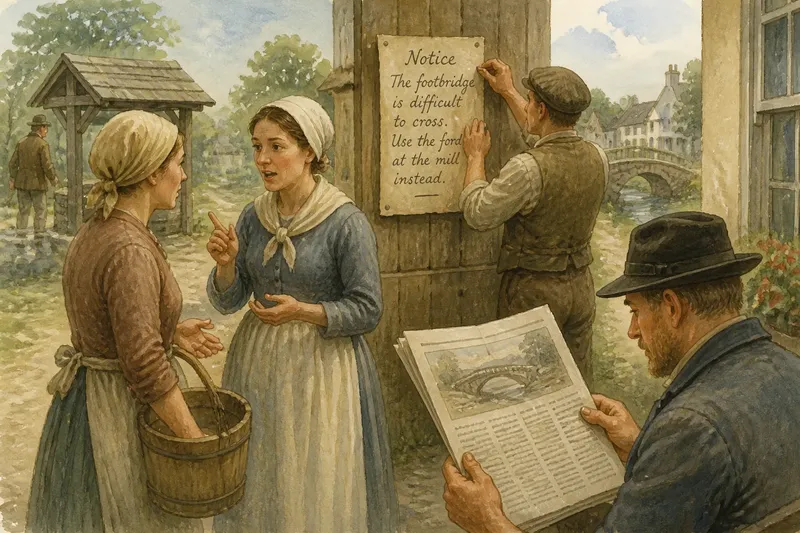
At the lane’s bend, someone pauses to ask whether the mill road is passable; by supper, the answer has traveled farther than the question. Before the noticeboard became a familiar village fixture, local news moved through ordinary encounters, handwritten notices, and community papers. Each carried information in a different way, shaped by who could hear it, where it was posted, and how long the message needed to last.
How did neighbours pass along news face to face?
Conversation carried news along the routes people already shared: a walk to the well, a turn through the market, a visit to a nearby home, or a pause outside a meeting place. Information traveled with the speaker, not in a fixed public record. A listener might pass it on at the next stop, adding context or asking someone to confirm a detail.
This method suited news that mattered to nearby people and could tolerate some uncertainty. A neighbor might mention that a cart was expected on the lane, or that a gathering had been discussed after worship. The message could be adjusted for its listener: one person needed the time, another needed to know who was welcome.
Its reach depended on social ties and timing. Someone who stayed close to home might hear a useful update quickly, while a person working farther afield could miss the same conversation. Repeated telling also made it easy for details to shift. A reported possibility could become a definite plan by the time it reached another household.
Why did people post written notices?
A written notice gave a message a place to wait for its audience. Instead of relying on one person to remember and repeat the details, the writer could leave a date, location, or instruction where passersby might read it. A notice attached to a door, gate, shop window, or other shared stopping place could reach people who arrived at different times.
Notices were useful for information that needed to stay stable: a change of meeting place, an upcoming sale, or a request for help. They also offered a way to address a broad local audience without visiting each household. But posting alone did not make a message visible to everyone. The location mattered, as did the reader’s ability to stop, read, and understand the words.
A notice could become outdated, be obscured, or remain unread by someone who did not pass its location. Handwriting, paper, and placement affected how legible it was. If an announcement changed, someone had to amend or remove the old version; otherwise, the wall could hold two conflicting accounts at once.
What did community papers add?
Community papers gathered more than one kind of local information into a publication that readers could keep and share. Alongside notices, they might carry meeting announcements, reports from nearby places, public decisions, and items submitted by residents. This gave local news a wider reach than a single doorway and a longer life than a conversation that vanished as people went their separate ways.
A paper also created a distinct audience. A reader could encounter news from a neighboring district without traveling there, while someone who missed a conversation or posted notice could catch up later. The printed page allowed several messages to sit side by side, making it easier to see what was happening across the community rather than only along one’s usual route.
That reach had limits. Readers needed access to the publication, and the information had to arrive in time to be useful. A paper’s selection and available space shaped what appeared; not every local concern could be included. Readers could also mistake publication for confirmation, even when an item was simply a report or announcement supplied by someone else.
Which messages suited each route?
The form of the message often determined how it traveled. A quick, changing update suited conversation because a listener could ask what had changed. A firm date or place suited a written notice because people could refer back to it. A community paper suited material intended for a broader readership or for later reference.
- Conversation: Useful for immediate, personal, or still-developing news, especially when a listener could ask follow-up questions.
- Posted notice: Useful when several people needed the same fixed details, such as a time, location, or request.
- Community paper: Useful when news concerned several neighborhoods, needed a fuller account, or could be read after the moment had passed.
These were not sealed categories. A person could hear about an event, see its details on a notice, then read a report afterward. The routes reinforced one another, but they did not do the same work. Conversation supplied exchange; the notice held a message in place; the paper assembled and circulated a larger record.
Who was likely to hear or read the news?
Access followed daily movement and social connection. People who visited a common meeting place or crossed a busy path had more chances to hear a spoken update or see a notice. Those who received visitors, worked in local trades, or took part in community gatherings could become important links between households.
Written channels brought other barriers. A person might not pass the posting place, be comfortable reading the hand, or receive the paper. Even when information was public in principle, it could remain out of reach in practice. The messenger’s choice of route, the notice’s location, and the paper’s circulation all influenced whose knowledge counted as current.
Imagine that a footbridge has become difficult to cross after heavy rain. One neighbor tells people heading toward the lane, a written notice at a nearby gathering place names the safer crossing, and a community paper later reports the change for readers beyond the immediate area. Each version serves a different audience and moment; none should be mistaken for a complete account of every person’s route.
What questions help explain how local news traveled?
Why did spoken news sometimes change as it traveled?
Each person could remember, shorten, or interpret a message differently, especially if details were incomplete. A listener might also add useful context, but that addition could blur the line between what was known and what was inferred.
Did a posted notice reach everyone in a community?
No; it reached people who encountered the posting place and could read the message. Someone living or working along another route might never see it, even if the notice was intended for everyone nearby.
How was a community paper different from a notice?
A notice held a particular message at one location, while a paper collected multiple items for readers to carry or keep. The paper could connect a wider area, though its timing and selection shaped what readers learned.
Why did the same news appear in more than one place?
Different routes reached different people and served different moments. Repetition could help an announcement travel, but a reader still needed to notice whether later versions added detail or corrected an earlier account.
What is not worth assuming about old local news?
It is not worth imagining that every community shared one complete, accurate account simply because neighbors knew one another. People moved along different routes, read different materials, and heard messages at different stages. Nor does a surviving paper or notice reveal everything people discussed privately or failed to record.
The useful distinction is between a message’s presence and its reach. A conversation could be vivid but brief; a notice could remain visible but be overlooked; a paper could travel farther yet arrive after circumstances changed. Seeing those differences makes the history of local news less like a single channel and more like a set of overlapping paths.
When looking at a local archive, old meeting place, or family account, ask where a message first appeared, who was likely to encounter it, and whether it was meant to inform, invite, warn, or record. Those questions clarify how neighbors passed along local news without assuming that any one route spoke for the whole community.