The Spare Room That Becomes a Storage Room by Default
A spare room storage room can crowd out useful space. Decide what the room should do, then give incoming household items a clear destination.
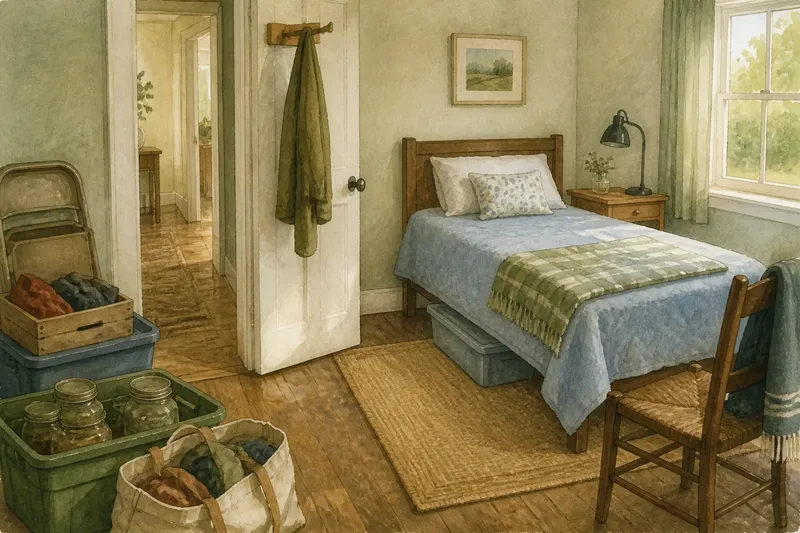
In a country house, a spare room storage room can form one box at a time: a bag of hand-me-down coats lands by the door, a folding chair leans against the wall, and a crate of jars waits for a decision. Soon, the room is hard to use, though nothing in it seems urgent. The problem is not simply too much stuff. The room never received a clear job.
Imagine a household with a small bedroom at the end of the hall. A relative has moved nearby, gardening supplies are scattered between the porch and shed, and the room is filling with things that might be useful later. The household wants to keep those items, but also wants a room that can serve a person who needs a quiet place to stay. The useful question is not “What can we fit in here?” It is “What should this room be ready to do?”
What does the room need to do first?
Before moving a single box, the household names the room’s main purpose: a simple guest room that can be made ready without a full-day clearing effort. That choice does not require a hotel-style setup. It means a bed or sleeping surface, a clear route to it, and enough uncluttered space for a guest to set down a bag.
They also decide what the room is not meant to do. It will not be the general cupboard for every item without a home, nor a workshop for messy garden jobs. Those limits matter because a room with no exclusions invites every household problem back inside.
This is a decision about readiness, not decoration. A room can be plain and still perform its role. An attractive paint color or matching storage baskets will not help if a visitor has to shift a pile of tools before sitting down.
Which belongings belong there?
The household sorts items by their connection to the room’s chosen use. Bedding and a spare blanket support the guest-room purpose. A lamp and a small chair may help, if they do not block the path. Canning jars, seed trays, a broken fan, and bags of clothing do not belong simply because the room has a free corner.
For each item, they choose a destination rather than making a vague “keep” pile:
- Used in the room: Keep it there, with a defined place.
- Used elsewhere in the house: Carry it to that room or its existing storage area.
- Used for outdoor work: Move it to a suitable spot such as a shed or porch cupboard, if available.
- Waiting for another person: Put it in a labeled, limited holding place and agree who will follow up.
- Unneeded or unusable: Decide whether to pass it on, repair it, recycle it, or dispose of it under local arrangements.
The category alone does not settle every choice. A bag of coats might be useful to a neighbor, while damp or damaged items may need a different decision. The point is to stop treating “could be useful someday” as a storage address.
How can the household keep the decision visible?
They make the room’s purpose easy to remember by keeping one modest storage area for guest supplies. A lidded box under the bed might hold clean sheets and a spare blanket; a hook behind the door might hold a guest’s coat. The box is not a license to fill every corner. It has a boundary, and anything that no longer fits prompts a fresh choice.
For items that must stay nearby but do not serve the room, the household chooses storage based on use. Garden twine and gloves go with gardening tools, not with guest bedding. Jars used for preserving go where the household handles that work. If the shed is damp, fragile supplies may need a drier location; the answer depends on the item and the conditions, not on a universal rule.
A small note inside the room’s closet can state its purpose and identify the guest-supply box. This is more useful than a row of elaborate labels for every object. It gives household members a shared reference when someone is tempted to leave another “temporary” item there.
What questions help when the choice feels difficult?
What if the household may need the item later?
Ask what specific use is expected and where the item would be used. If the answer is uncertain, keep only a manageable amount in a designated holding place rather than letting the spare room become the holding place.
What if the room has to serve guests and storage?
Choose the guest setup first, then allow only storage that stays out of the way and can be accessed without moving the sleeping area. If stored items repeatedly prevent the room from being ready, the two roles are competing rather than sharing comfortably.
What if another room has no space either?
That points to a household storage problem, not a reason to preserve the spare room’s default role. Consider whether some items can be passed along, used up, repaired, or stored with the activity they support.
Does the room need to look finished?
No. A clear floor, usable bed, working light, and sensible place for a guest’s belongings may be enough. Spending effort on decor before removing unrelated overflow is unlikely to solve the room’s underlying problem.
What changes after the room has a job?
In this invented situation, the household carries the jars to the pantry area, moves the garden supplies to a dry section of the shed, and sorts the coats into items to offer, keep, or let go. They leave the broken fan out of the guest room while deciding whether it can be repaired. The observable result is not a showroom. It is a room where someone can enter, set down a bag, and sleep without first clearing a route.
That result also makes later decisions easier. When a new box arrives, someone can ask whether it supports the room’s purpose. If it does not, it needs another destination or a decision about its future. The question interrupts the quiet habit of placing things wherever space happens to remain.
For a spare room storage room, the lasting change comes from deciding its first purpose and making that decision visible in the way the space is used. A household does not need to solve every storage issue at once. It can begin by restoring one clear function and refusing to let an undefined corner quietly take it back.